A strategy game for iPhone and iPad
Earth has 75 years. Find it a Plan B.
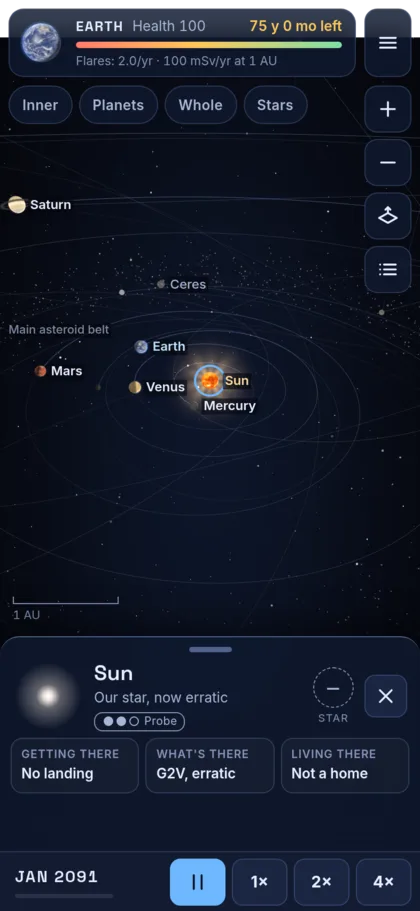
The Sun is turning. From January 2091 you have until 2166 to research the ships, scan the worlds and send the first people out, from a real 3D map of our neighbouring stars.
In development at Iron Buffalo Studios. An iPhone and iPad beta on TestFlight is next.
The premise
Not a planet B. A planet B-minus.
In 2091 the Sun's flares stop behaving. The models agree on one thing: in 75 years Earth will not support people out in the open. There is no perfect second Earth within reach, only worlds that are a little too cold, too heavy, too dry or too far.
You run the effort. You choose what to research, what to build, which worlds to scan and who goes. Every year you spend learning is a year less to get people there.
- January 2091The flares begin. The clock starts.
- The first decadesProbes, telescopes and drives. Mars and the Moon are the first steps.
- The middle yearsShips in flight for years, colonies holding on, haulers bringing back what they find.
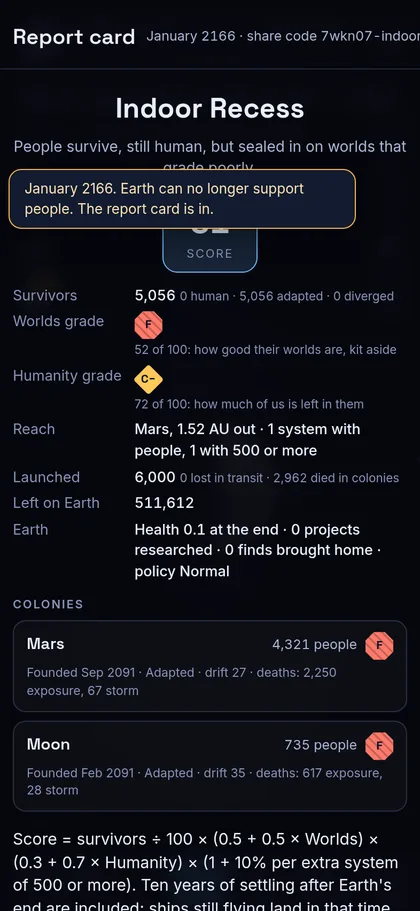
- January 2166Earth is done. An epilogue tells what became of everyone, and a report card grades the worlds you reached.
How it plays
Research. Scan. Launch. Hold on.
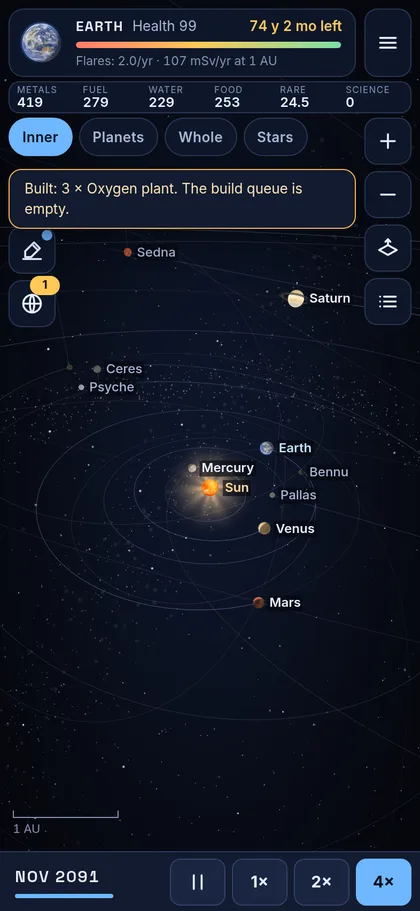
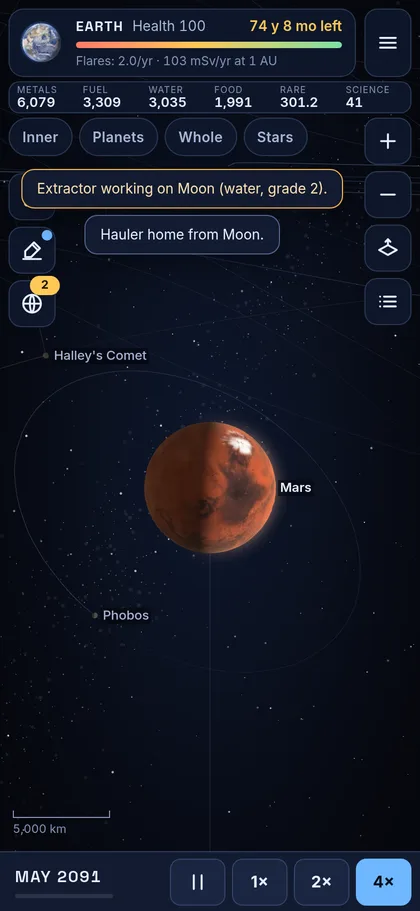
One run is 75 years, played at your own pace: pause any time, or run the years at 1x, 2x or 4x.
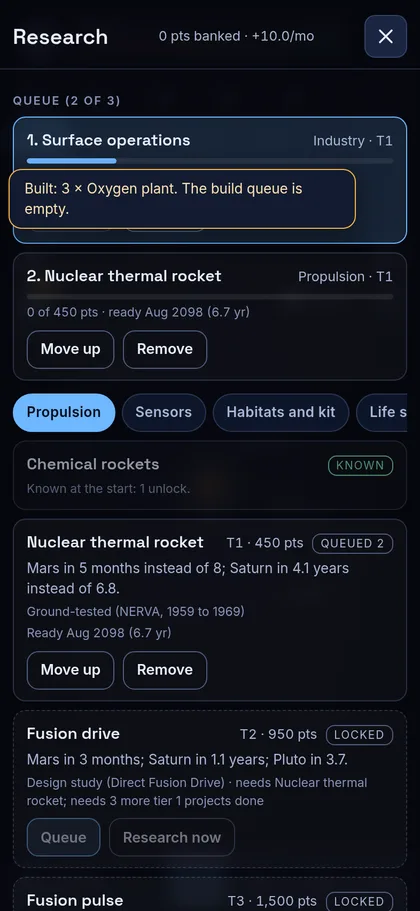
32 projects, from real science
Nuclear thermal rockets, fusion drives, habitats, life support and the kit people need to survive outside. Each one says what it changes and what it is based on.
Know before you go
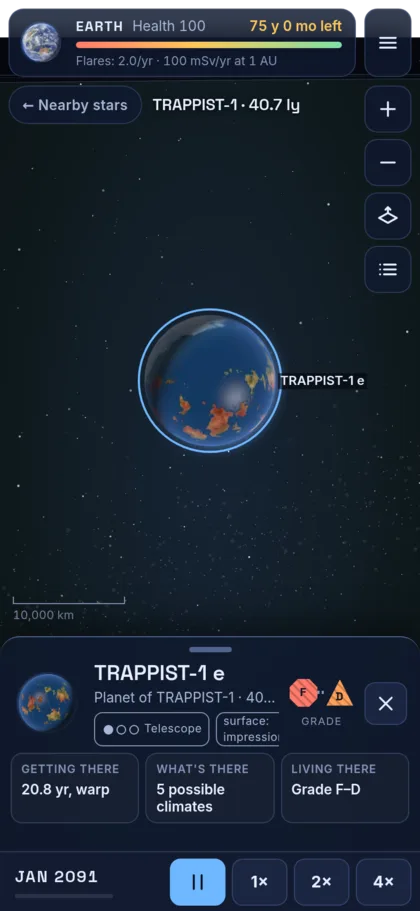
Telescopes, probes and landers turn a dot on the map into a dossier: gravity, temperature, air, water, and what it would take to live there.
Plan every ship
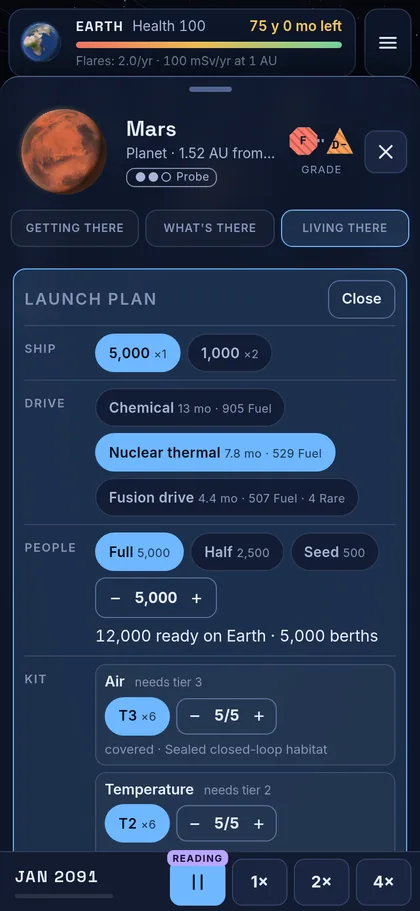
Choose the ship, the drive, how many people and which kit. The launch plan gives honest odds before anyone leaves, and the ship flies on the map for real years.
Keep them alive
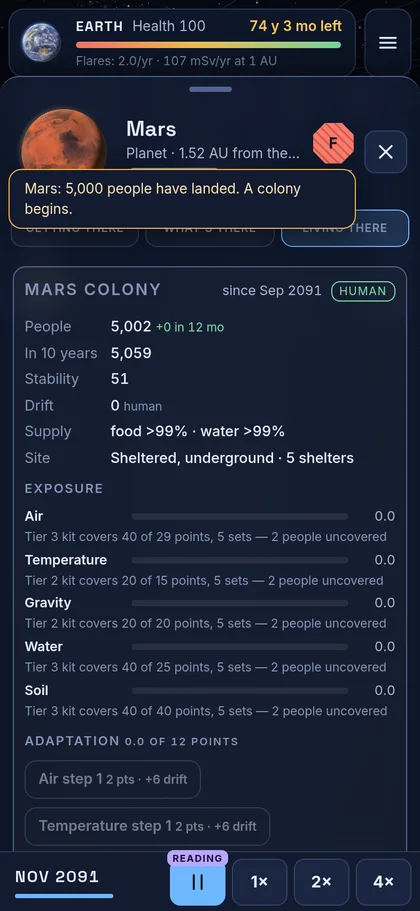
Colonies face exposure, storms, shortages and slow change. Haulers bring extractors, rovers and supplies. Some colonies thrive. Some are lost.
The science
A real neighbourhood, real distances
The map is built from published data, so the hard part of the game is the hard part of the real problem: space is big, and ships are slow.
Planet orbits follow NASA JPL data and the nearby stars are placed at their measured distances. No one has photographed the surface of a planet around another star, so those surfaces are artist impressions generated with AI from each world's measured data, and the game labels them as impressions. Solar System surfaces use maps made from spacecraft data.
Beta
Play it first
The iPhone and iPad beta goes out on Apple's TestFlight. Leave your email and you'll get the invite when it opens, plus the occasional dev update. Nothing else.
Your email is used only for the beta and Planet B-Minus news, never sold or shared. One email to hello@planetbminus.com removes it. Privacy.
Who's making it
Iron Buffalo Studios
Planet B-Minus is made by Iron Buffalo Studios, an independent game studio in Houston, Texas. The studio also makes Epochfall, Epochfall: Dynasties and Fantasy × AI.